
Game Objective
Equipment and Setup
Bid Whist doesn’t need too many extra odds and ends in order to play. In fact, most households have everything they need right on the counter or in a junk drawer.
It makes rustling up a game of Bid Whist easy as pie!
Required Materials
Bid Whist uses a standard 52-card deck plus the two Jokers. You’ll also need some way to keep score, usually just a scratch pad where the simple calculations can be made.
Tradition holds that Bid Whist gets loud from time-to-time. You’ll want a location that’s cool with that. (Here at Bid-Whist.com, you’ve got the perfect environment all set!)




Initial Layout




Card Distribution and Game Start
Dealing Cards
Someone volunteers to be the first dealer or the dealer is decided at random. Many game groups have their own unique way of choosing the first dealer. After the first hand, dealer responsibility rotates clockwise.
Each player receives 12 cards. The remaining 6 cards go into a pile in front of the dealer face-down to form the Kitty.
Order of Play
Once the deal is done, players take turns, starting with the player to the dealer’s left, entering into a bidding phase.
Players can bid a number—most of the time, between 4 and 7, but it depends on the strength of their hand—to declare how many books (called tricks in most games) they believe their team can win, or they can pass.
When bidding, a player also specifies the direction of the ranking of cards. If they bid Uptown, high cards win. If they choose Downtown, low cards win. They also choose a trump suit or declare No Trump.
The highest bidder gets to add the Kitty to their hand and discards any six cards from their original hand to return to a 12-card total. That player then declares the trump suit (if any), the direction (Uptown or Downtown), and leads the first card.
Joker Usage and cards force
The two jokers in the game must be different in order to distinguish them. In fact, the red joker is stronger than the black joker.
Uptown Bid
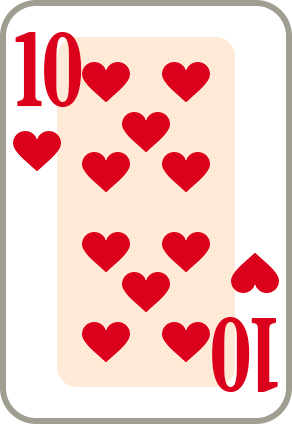
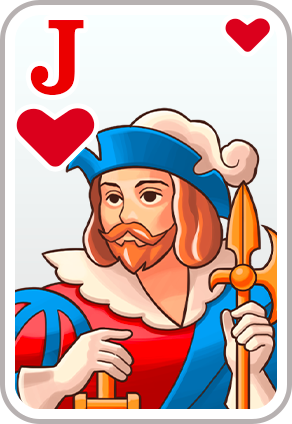
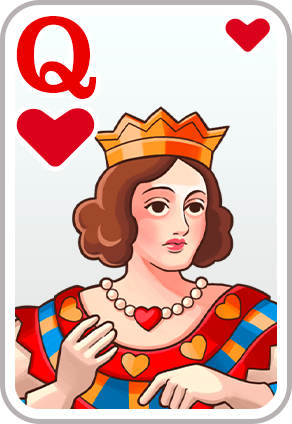
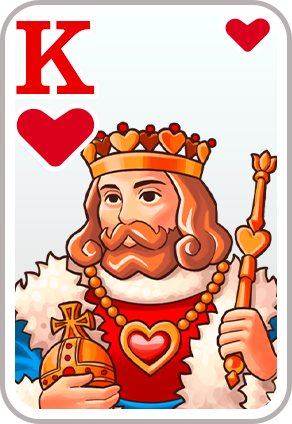
Here is an example of the card order and strength when Hearts are trump (In this case, the 2 of Hearts is the weakest card) :
Downtown Bid
Here is an example of the card order and strength when Hearts are trump (The King is the weakest card) :
Turn Structure
Phases of a Turn
Available Actions
On each turn, players must follow suit if they can (for example, if a Heart is led, everyone else must play a Heart if they have one).
If a player can’t follow suit, they may cut by playing a trump card if that hand has a declared trump suit. They may also throw off a card from another suit.
The highest card in the suit that was led wins the book unless a trump card has been played, in which case the highest trump card played that round takes the book.
Play continues until all thirteen books have been won.
Scoring System and Winning Conditions
Point Calculation
After the round is over, teams then count their books. If the bidding team has met their bid, scoring works like this, based on what their bid was:
- 4 book bid – 0 points
This is the lowest legal bid. Making it doesn’t earn points, but failing it still causes a loss. - 5 book bid – 1 point
A moderate bid. If the bidding team wins at least 5 tricks, they earn 1 point. If not, they lose 1 point. - 6 book bid – 2 points
A stronger bid. Winning at least 6 tricks earns 2 points, failing costs 2 points. - 7 book bid – 3 points
Making the bid gets you 3 points, missing it means you lose 3 points. - 8 book bid – 4 points
Very high stakes territory! Win 4 points if you succeed, lose 4 if you don’t. - 9 book bid – 5 points
Succeeding earns 5 points, missing it makes the team lose 5 points. - 10–12 book bid – 6 points
These are “board sweeps,” often called Boston. If you can pull it off, you get the maximum score of 6 points—but miss, and you’re penalized the full amount.
The opposing team only scores if they set the bidders or, in some variations, if they run a Boston—winning all 13 books, a major achievement that earns bonus points.
Game End
Specific Rules and Exceptions
In Cutthroat Whist, players do not bid. No trump is declared and there is no Kitty. The highest suit of the card led wins the book. This version of Whist is fast-paced and great for only three players.
You can also play with bidding but without the Kitty.
In the Jokers High version, Jokers are always the highest-ranking cards. Decide before the game starts which is the Big Joker (the highest card) and the Little Joker (the second-highest card).
Or play Deuces Wild! Two of the Twos become the highest cards. Again, before play starts, decide which is the Big and which is the Little. In some games the Twos even outrank the Jokers!